Voice 1
Welcome to Spotlight. I’m Colin Lowther.
Voice 2
And I’m Megan Nollet. Spotlight uses a special English method of broadcasting. It is easier for people to understand, no matter where in the world they live.
Click here to follow along with this program on YouTube.
Voice 1
He became popular all over the world. But as a child he had no friends. He felt alone and sad while growing up. Yet as an adult he connected with children and made them feel special. He did not like television when he first saw it. But he ended up making a popular television program. He was a quiet, private person. Yet he became famous. He taught people how to talk to children. But at times he struggled to communicate with his own two sons.
Voice 2
Rogers exercised every day, never smoked cigarettes or drank alcohol, and ate healthy foods. Yet he died of stomach cancer. His life was filled with unexpected turns. But he was dependable for so many people. He wanted to help however he could. He chose to look into children’s eyes and tell them, “You are special. You are special to me.”
Voice 1
A neighborhood is a community within a larger town. Neighbors are people who live close by. Today’s Spotlight looks at Fred Rogers and his television show Mister Rogers’ Neighborhood.
Voice 2
Rogers grew up in the state of Pennsylvania in the United States. He was often sick as a child. He was also overweight. Other children were not nice to him. They called him “Fat Freddy.” Rogers felt lonely and sad. He spent a lot of time in his bedroom where he began to develop his imagination. He created characters and stories.
Voice 1
In high school, Rogers made friends and got involved in different activities. After graduating, he studied music in college. In 1951, Rogers decided to work on television. He said:
Voice 3
“I went into working on television because I hated it. I thought there is some way of using this new instrument to encourage those who watched and listened.”
Voice 2
Rogers worked at television stations in New York City and Pittsburgh. In Pittsburgh, he helped start WQED, the first community-supported educational television station in the United States. He worked as the station’s program manager. He also helped on one of WQED’s shows called The Children’s Corner.
Voice 1
Rogers wrote music for The Children’s Corner. He also worked with puppets. Puppets are toys shaped like little animals and people. Rogers put his hand inside of a puppet and held his arm up while he hid below. The television camera could only see the puppet he held up. Rogers used his hand to open and close the puppet’s mouth as if it were talking. Rogers spoke for the puppet using different voices he created. He named some of the puppets Daniel Tiger, King Friday the XIII, and X the Owl. He later used these same puppets on his show Mister Rogers’ Neighborhood.
Voice 2
Rogers continued to study and learn to prepare for his career in television. While working at WQED, he studied theology at seminary, a school for religious studies. Rogers graduated from seminary and became a licensed minister. Rogers was a follower of Jesus. He felt he was called by God to reach children through television. Rogers also earned his master’s degree in child development from the University of Pittsburgh’s Graduate School of Child Development.
Voice 1
Rogers moved to Toronto, Canada, to work for the Canadian Broadcasting Corporation, or CBC. There he created a new television show called Misterogers. Rogers used his puppets again, but for the first time he also talked to the camera. The head of Children’s Programming at CBC saw how well Rogers worked with children. He asked Rogers to talk to the audience because he knew children watching at home would enjoy him.
Voice 2
In 1966, Rogers moved the show Misterogers back to WQED in Pittsburgh where he used to work. He renamed the show Misterogers’ Neighborhood. WQED broadcast the first season of the show to the northeastern part of the United States. The station then had to cancel Misterogers’ Neighborhood because of lack of funding.
Voice 1
However, many people wrote letters and called the station asking for the show to return. The Sears Roebuck Foundation gave money for Misterogers’ Neighborhood to be broadcast on National Educational Television throughout the United States. In 1970, the Public Broadcasting Service, or PBS, replaced National Educational Television and changed the spelling of Rogers’ show to Mister Rogers’ Neighborhood, with a space between the words “Mister” and “Rogers.” This remained the show’s name until its final season in 2001.
Voice 2
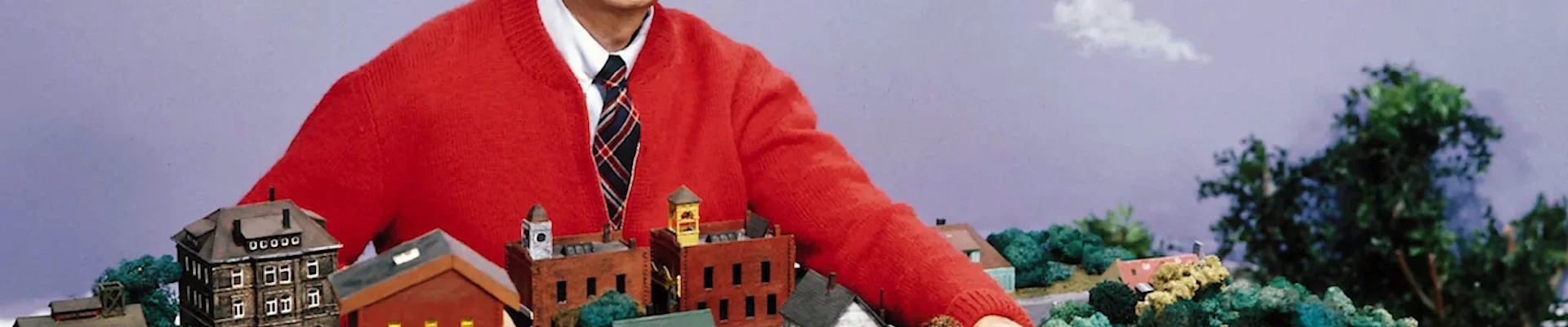
Rogers began each episode of Mister Rogers’ Neighborhood by walking into a room designed as the living room of a house. He took off his coat and hung it in the closet. Rogers put on a more calmly. He created a warm, friendly atmosphere where children could trust him. Rogers welcomed everyone to watch him on television. He sang his song, “Won’t You Be My Neighbor?” The song finishes with the words:
“Neighbors are people who are close to us. And friends are people who are close to our hearts. I like to think of you as my neighbor and my friend.”
Voice 1
Rogers felt it was important to discuss serious subjects on his show like death, divorce, and racism. Racism is treating another person unfairly based on the color of his or her skin. Rogers knew children needed to be prepared emotionally to experience these issues. Rogers said:
Voice 3
“The world is not a kind place. That is something all children learn for themselves, whether we want them to or not. But it is something they really need our help to understand.”
Voice 2
During the show, Rogers visited the “Neighborhood of Make-Believe.” Make-believe is imagining or acting out a situation that is not real. Rogers used his puppets in the “Neighborhood of Make-Believe” to share stories about the episode’s subject. The neighborhood was a puppet kingdom ruled by King Friday the XIII. Puppet characters like Daniel Tiger, Lady Elaine Fairchilde, and X the Owl talked with friendly humans about their problems concerning the show’s subject. They helped each other learn and grow.
Voice 1
At the end of each episode, Rogers took off his sweater and comfortable shoes and put on the coat and work shoes he had arrived in. As he changed, he sang another song he wrote called “It is Such a Good Feeling.” It included these words:
“There is only one person in the whole world exactly like you. And that is you yourself. And people can like you exactly how you are.”
Voice 2
Though Rogers was excellent at reaching out to children through his show, he still struggled at times to talk to his own children. It was not easy for his children to have a father who was perfect in so many others’ eyes. It was hard for his sons to live up to the standard Rogers set. In fact, the oldest of his two sons moved away from home and would not speak to Rogers for some time. But Rogers tried to practice what he taught on his show. He was patient and forgiving. He loved his oldest son without judgment. Rogers made more time for his son. Rogers listened to what he needed. He made sure his son felt important.
Voice 1
Rogers and his talented team made 912 episodes of Mister Rogers’ Neighborhood. The show was on television for 31 seasons. Rogers won many awards during his career, including the Presidential Medal of Freedom and two Peabody Awards for excellence in children’s television. Rogers never drank alcohol or smoked cigarettes, and he swam every day. But he died from stomach cancer at the age of 74. He is remembered as a gentle, honest, caring person who spoke quietly and lovingly to generations of children. Rogers not only made children feel safe to learn, but he also taught them to learn while playing. He said:
Voice 3
“For children, playing is serious learning. Play is a way to deal with life and to prepare for adulthood. Playing is a way to solve problems and to express feelings. In fact, play is the real work of childhood.”
Voice 2
Why do you think children enjoyed Mister Rogers’ Neighborhood so much? What part of this show seems most interesting to you? Now that Mr. Rogers has died, do you think someone else should try to make new episodes of the show? You can leave a comment on our website at www.spotlightenglish.com. You can also find us on YouTube, Facebook, TikTtok, Instagram, and X. You can also get Spotlight episodes delivered directly to your Android or Apple device through our free official Spotlight English app.
Voice 1
The writer of this episode was Peter Anderson. The producer was Michio Ozaki. The voices you heard were from the United Kingdom and the United States. All quotes were adapted for this episode and voiced by Spotlight. No AI or artificial intelligence was used in this episode. Spotlight episodes are written, voiced, and produced by real people for real people, no matter where in the world they live. This episode is called, “Mister Rogers’ Neighborhood.”
Voice 2
We hope you can join us again for the next Spotlight episode. Goodbye.
Question:
Why do you think children enjoyed Mister Rogers’ Neighborhood so much? What part of this show seems most interesting to you? Now that Mr. Rogers has died, do you think someone else should try to make new episodes of the show?