Voice 1
Welcome to Spotlight. I’m Megan Nollet.
Voice 2
And I’m Patrick Woodward. Spotlight uses a special English method of broadcasting. It is easier for people to understand, no matter where in the world they live.
Click here to follow along with this program on YouTube.
Voice 1
Polina Gelman turns off her plane’s engine. Her engine goes quiet as she floats over Nazi-occupied Russia. The Nazi gunners have their eyes to the sky. But Gelman’s plane has no power and makes no noise. A small smile crosses her face as she fingers the switch that will release the airplane bomb. Soon, she will make another small hole in the Nazi war machine. Soon, she will be back for another round.
Voice 2
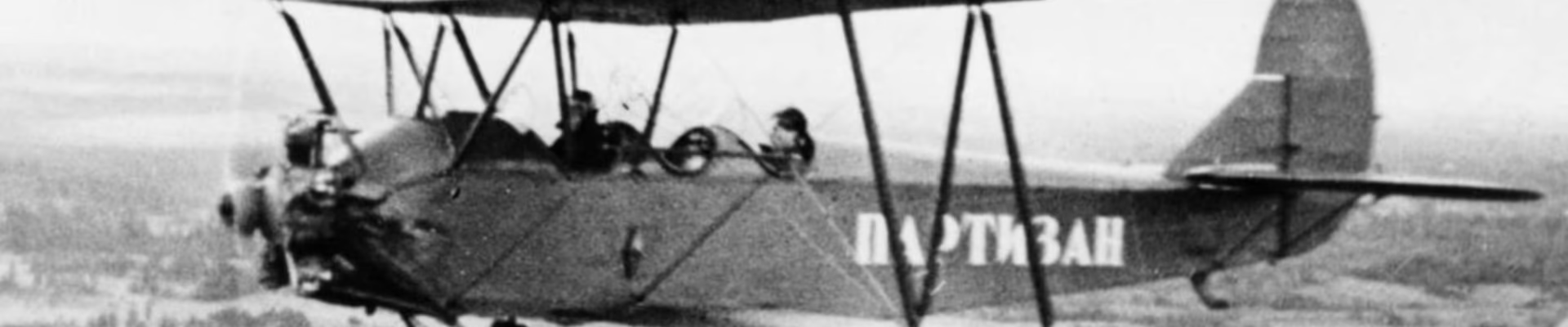
Polina Gelman was a member of Russia’s 588th Night Bomber Aviation Regiment. They were nicknamed the “Night Witches” by their enemies. This group of pilots faced impossible odds to fight for their country. In doing so, they served their country. They also made history as the first all-female group of military pilots in history. Today’s Spotlight is on the amazing story of the Night Witches.
Voice 1
The Night Witches would not have been possible without Marina Raskova. The first woman in the Soviet Union to achieve the position of a paid navigator, Raskova was a leader in air travel. But when the Soviets joined World War Two, they made a rule. Women could fly, but they could not fight.
Voice 2
This rule angered Raskova. The Soviet Union was in a bad place. She believed that everyone, not just men, should be able to fight for their country. She was famous enough in her country that her opinion mattered. She even asked the Soviet leader, Joseph Stalin, for an exception. For her, he made one.
Voice 1
About 1200 people were accepted into one of three airplane fighting groups. About 400 women went to the Night Bomber Aviation Regiment. Polina Gelman and Galya Dokutovich were college students who joined the regiment. Lyuba Vinogradova is a Russian historian. She spoke about the two best friends with the British Broadcasting Corporation.
Voice 3
“They were completely in love with danger. They wanted to fly. They were wild about flying. And second, they were extremely loyal to their country. So, they both signed up.”
Voice 2
However, the women of the 588th faced difficulties even before they began to fly. Many of their male partners did not believe they could do a good job. They were given clothing designed for men, which was often too big for them to wear. Worst of all, there were not enough planes for the women. The Night Witches were given old planes not built for fighting.
Voice 1
These airplanes were made mostly of low-cost wood and other materials. These were old planes and had no instruments to help the women know where to go. They had to use maps and other difficult-to-use tools. The airplanes had open cockpits. These were not covered. Pilots had to put up with terrible cold weather. The planes could only fly 145 kilometers per hour and had to stay close to the ground. Pilots did not carry anything to slow their fall if their airplanes crashed. This would have made the airplanes too heavy to fly.
Voice 2
But the Night Witches turned these problems into a success. Flying at night made their attacks unexpected. The old planes did not show up on German sensors. These could turn more quickly than modern planes and could land anywhere. This made the planes perfect for surprise attacks. If the Night Witches turned off their engines for a short time, they were very difficult to hear or see. This is why the Nazis called them the “Night Witches.” They appeared from nowhere, as if by magic.
Voice 1
Part of the reason these planes flew at night was to attack Nazi targets more easily. But another reason was to make it difficult for their enemies to sleep. The Night Witches’ work hours also meant they did not sleep much. Larisa Litvinova-Rozanova was one of the Night Witches. She told the New York Times:
Voice 4
“We even had a kind of agreement between the pilot and the navigator. One of us would sleep going to the target and the other returning to base.”
Voice 2
The Night Witches were not always successful. On one of the worst nights of the war, the Night Witches lost eight women to German airplanes. Most nights they were tired, cold, and unhappy. But the women of the 588th continued to fight, if only to prove that they could.
Voice 1
At home, the Night Witches championed the fact that they were women, and proud of it. In their free time, they made clothing and danced just as their mothers had. Some painted their planes with flowers. They wore makeup. Like the men, it was their job to defend their country. But these women did their job in a way that was all their own.
Voice 2
The end of the war came as a change for many of the Night Witches. Each pilot flew about eight hundred times. Thirty of their sisters had died in battle. Twenty-four of these women earned one of their country’s most important awards: The Hero of the Soviet Union. But the Night Witches did not fly during the Soviet Victory Day celebration. Their planes were considered to be too slow. And, six months after their victory, the Soviets decided that the 588th night bombing regiment was no longer necessary.
Voice 1
Most of the Night Witches went back to their normal lives. Polina Gelman returned to school to study languages. She married, had a child, and later worked in universities as an economist. It was not until recently that people noticed her efforts to defeat the Nazis. Her story, like many others, almost disappeared. She told the New York Times:
Voice 5
“Some people like to talk too much about what they have done. I would not want to look like that.”
Voice 2
Gelman and the rest of the Night Witches did not seem to need recognition for what they did. They acted out of love for their country. They acted out of love for freedom. Most saw their work as a simple service. But their desire to fight was more than that. It was an act of bravery that went beyond the reasons they fought. In that, these women deserve our respect. Gelman told the British Broadcasting Corporation:
Voice 5
“It was their free will. That which is done at the call of the heart is always done better than that which is done because you must.”
Voice 1
Have you ever heard of the “Night Witches” before? Did you learn anything new from this story? Have you ever done something that was very difficult? What was it? Why did you do it?
Voice 2
You can leave a comment on our website at www.spotlightenglish.com. You can also find us on YouTube, Facebook, TikTok, Instagram, and X. You can also get Spotlight episodes delivered directly to your Android or Apple device through our free official Spotlight English app.
Voice 1
The writer of this program was Dan Christmann. The producer was Michio Ozaki. The voices you heard were from the United States and the United Kingdom. All quotes were adapted for this episode and voiced by Spotlight. No AI or artificial intelligence was used in this episode. Spotlight episodes are written, voiced, and produced by real people for real people, no matter where in the world they live. This episode is called, “The Night Witches.”
Voice 2
We hope you can join us again for the next Spotlight episode. Goodbye.
Questions:
Have you ever heard of the “Night Witches” before? Did you learn anything new from this story? Have you ever done something that was very difficult? What was it? Why did you do it?