Voice 1
Welcome to Spotlight. I’m Roger Basick.
Voice 2
And I’m Paula Devis. Spotlight uses a special English method of broadcasting. It is easier for people to understand, no matter where in the world they live.
Click here to follow along with this program on YouTube.
Voice 1
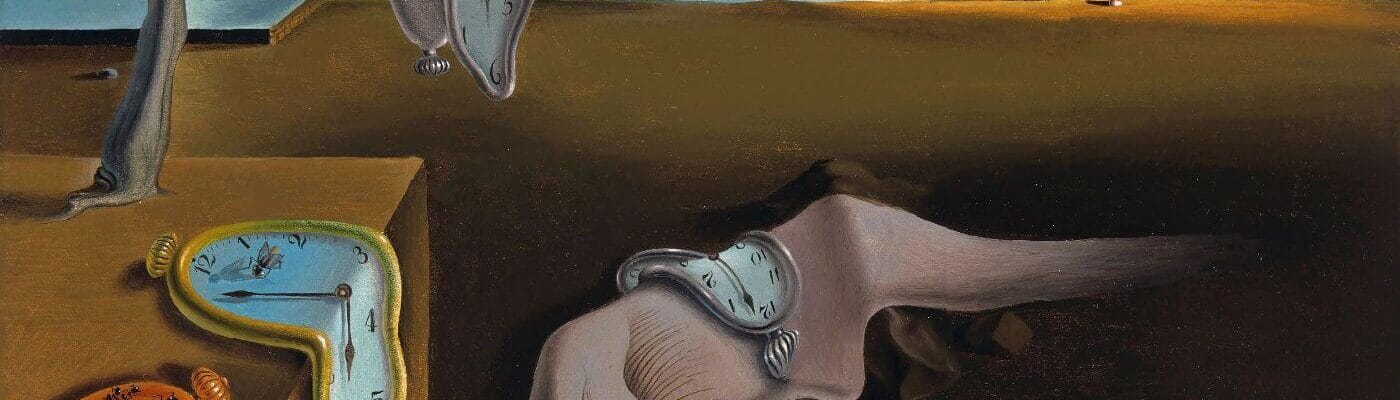
The clocks are melting. As you look at the painting, that is the main thing you see. The rest of the dreamlike landscape seems unclear. There is a shining lake, a dead tree, and the shape of something that may be a man’s sleeping face. But all of these are minor details compared to the clocks. Each shows a different time. Each hangs over the edge of something as if it was made from uncooked bread.
Voice 2
This is a painting called The Persistence of Memory, by the Spanish artist Salvador Dali. One of Dali’s most important paintings, The Persistence of Memory seems to show how time slides away. We remember people and places incorrectly. At times, our memories seem to slip away, just like the melting clocks in Dali’s paintings.
Voice 1
Salvador Dali was one of the most important artists of the 20th century. Working mostly as a painter, Dali’s dreamlike paintings were designed to shock people. As part of the Surrealist art movement, Dali’s art changed how many saw the world. But with a larger-than-life personality, Dali’s life may now be even more famous than his art. Today’s Spotlight is on the dream life of Salvador Dali.
Voice 2
Salvador Dali was born on May 11, 1904. He was born into a wealthy family. His mother recognized his skill for painting at a young age. She had Dali’s father put him through art school in Madrid. Though she died when he was just sixteen, Dali would prove his mother right.
Voice 1
In school, Dali began to experiment with modern styles of painting. Though originally a classical painter, new artistic movements like Cubism and Futurism captured the young man’s interest. These non-traditional styles of painting offer new ways to paint.
Voice 2
However, Dali’s most important artistic influence came from the Surrealist movement. Surrealism was not a style of painting, as Cubism or Futurism was. Instead, Surrealism was a philosophy, or way of thinking about art. Andre Breton was one of the founders of Surrealism. He wrote that Surrealism’s goal was to destroy the separation between the dreaming and the waking worlds. There was no single subject or way of painting. A Surrealist’s goal was to do something to people.
Voice 1
Surrealism interested Dali greatly. He began experimenting with it. He grew very interested in painting scenes from his dreams. He invented ways of waking himself from deep sleep so he could remember his dreams. He began holding things in his hand when he was about to fall asleep. As he fell asleep, the object he was holding would drop to the floor, waking him. He would paint whatever he saw in that brief dream.
Voice 2
Dali’s dream landscapes made him famous. People had different opinions about them. They invited others to discuss their opinions. His colorful personality was also talked about. The more famous he became, the stranger he began to act. Once, he gave a talk in a large diving outfit while walking two large dogs. It was so hot inside the outfit that he almost died. At another time he filled a car with cauliflower— a white vegetable. He rode around Paris, giving them away. Dali once wrote:
Voice 3
“Every morning when I wake up, I experience a great joy—the joy of being Salvador Dali. Then I ask myself happily: what wonderful things is this Salvador Dali going to do today?”
Voice 1
But Dali’s personality also got him into trouble. He often seemed to rebel against what was most popular among his friends. Francisco Franco was the dictator of Spain from 1939 to 1975 r . He ruled the country through military force. When the Surrealists spoke against Franco, Dali publicly supported him. Dali once even announced that he thought Adolf Hitler was sexy.
Voice 2
Whether Dali truly believed these things is unclear. Much of what he did in his public life was meant to shock others. His desire for fame seemed to come from a deep need for people to notice him. Whether he was noticed for good or bad things did not seem to matter to Dali.
Voice 1
Dali’s need for money and fame pushed away many of his Surrealist friends. In 1939, the Surrealists told Dali he no longer belonged in their movement. His behavior also hurt how people viewed his art. Many felt he no longer believed in creating art that changed people. Others found that his strange life made more of a statement than his painting. Dawn Andes is a teacher at the University of Essex who studies Dali. She told the Smithsonian Magazine:
Voice 4
“He had a personality that was hard to see past. I have had to work very hard to make it clear how serious he really was.”
Voice 2
As time went by, Dali moved away from his Surrealist interest. After World War Two, he stopped painting his dreams. He became a Catholic, a branch of the Christian faith. And he became interested in nuclear science. He developed a style that he called nuclear mysticism, which brought these two interests together. He also went back to his classical roots, based on the works of older painters like Diego Velasquez and Raphael. Michael Taylor works at the Philadelphia Museum of Art. He told Smithsonian:
Voice 5
“Dali was very mindful of his times. He said to himself: Velázquez and Raphael. If they lived in a nuclear age, what would they paint?”
Voice 1
Dali’s new work often showed the death of Jesus Christ. This is an important part of the Christian faith. Through Christ’s death, Christians believe they are forgiven for the wrong things they have done in life. Dali’s paintings such as Corpus Hypercubus often compared Christ to an atom, the smallest form of matter. Dali believed that Christ’s death was not just a moment in time. Like the atom, it existed in everything.
Voice 2
Whether people liked it or not, Dali’s new style of painting was not as popular as his Surreal paintings. Nuclear mysticism was more difficult to understand than paintings of dreams. As he grew older, Dali was no longer respected by other artists. Then, in 1979, Dali’s health failed. Doctors treated him for depression and drug dependence. He also may have had Parkinson’s disease. His arms shook, making painting impossible. He painted his last work, The Swallow’s Tail, in 1984.
Voice 1
Salvador Dali died of heart disease in 1989. He was 84 years old. He left behind a very complicated history. There were few people who could touch his technical skills as an artist. As a man, he was larger than life. His personality sometimes threatened his art. But at his core, Dali was a creator of strange things. He brought life-changing ideas to life with his painter’s tools. These dream worlds will stay with us for many years to come.
Voice 2
Have you ever seen any of Salvador Dali’s paintings? Which one is your favorite? What do you like about it?
Voice 1
You can leave a comment on our website at www.spotlightenglish.com. You can also find us on YouTube, Facebook, TikTok, Instagram, and X. You can also get Spotlight episodes delivered directly to your Android or Apple device through our free official Spotlight English app.
Voice 2
The writer of this program was Dan Christmann. The producer was Michio Ozaki. The voices you heard were from the United States and the United Kingdom. All quotes were adapted for this episode and voiced by Spotlight. No AI or artificial intelligence was used in this episode. Spotlight episodes are written, voiced, and produced by real people for real people, no matter where in the world they live. This episode is called, “The Dream Life of Salvador Dali.”
Voice 1
We hope you can join us again for the next Spotlight episode. Goodbye.
Question:
Have you ever seen any of Salvador Dali’s paintings? Which one is your favorite? What do you like about it?