
Voice 1
Welcome to Spotlight. I’m Megan Nollet.
Voice 2
And I’m Patrick Woodward. Spotlight uses a special English method of broadcasting. It is easier for people to understand, no matter where in the world they live.
Click here to follow along with this program on YouTube.
Voice 1
Famous author F. Scott Fitzgerald believed someone could only become successful in one area of their life. If the person was lucky enough to find success, nothing could ever compare to it. It would be their life’s work. But Fitzgerald never met Mike Reid.
Voice 2
On today’s Spotlight, we look at a few people. They all achieved amazing success in two different areas of their lives. We also examine someone who overcame terrible pain to become the best at what he did.
Voice 1
Mike Reid played American football in college for Penn State University. He played on the defensive line. His job was to stop the other team from moving the ball forward. He was very good at it. During his last year, the National Collegiate Athletic Association voted for him as the best defensive player in America. The National Football League’s Cincinnati Bengals picked Reid to be a player. He was one of the best defensive players in the league for five years. But suddenly, he quit.
Voice 2
Reid was one of the best football players in the world. Yet he stopped playing. His teammates and fans were shocked, but Reid wanted to do something else. He wanted to become a musician. He studied music in college. He played the piano, a large-key instrument. It made a sound when the keys were pressed. He wanted to write songs.
Voice 1
Many of his coaches, friends, and teammates thought Reid was making a mistake. It was very difficult to get into the National Football League (NFL). The chances of a person becoming successful in the music business were also low. But for the same person to do both? No one thought Reid could do it. However, Reid’s father was supportive of his career change. Reid later said about his father:
Voice 3
“He was probably the most supportive person in my decision to leave football. He hated his job as a railroad worker. He could see that music was what I loved.”
Voice 2
Reid struggled at first. It took him years to meet the right people in the music business. He moved to Nashville, Tennessee, an important city for American music. He played small shows by himself to gain attention. He joined several songwriting groups. Finally, he became a songwriter for country music singer, Ronnie Milsap. Milsap gained great success with some of Reid’s songs. This led to more work for Reid. He would go on to write popular songs for other well-known singers.
Voice 1
Reid won a Grammy Award, the highest award in music. He performed as a pianist in many music groups. The Nashville Songwriters Hall of Fame gave him an award.
Voice 2
But his greatest accomplishment was writing the music for the song “I Can’t Make You Love Me.” Bonnie Raitt sang the song. It became her most famous work. Allen Shamblin wrote the words for the song. Shamblin said:
Voice 4
“One day, Reid said, ‘Come upstairs,’ where his piano was. He sat down and started playing. It was some of the best music I had heard. I knew it was the best thing I had ever been a part of.”
Voice 1
Rolling Stone Magazine picked the song “I Can’t Make You Love Me” as one of the five hundred greatest songs ever written. Bonnie Raitt recorded the song in just one try. Her singing was soft and sad yet also strong and powerful. Many other singers have recorded the song since Raitt made it famous. Critics called it one of the finest songs written during the second half of the twentieth century. And the music was beautifully written by Mike Reid, an ex-NFL lineman.
Voice 2
Second acts are not just for famous people. Steve Cobb was born and raised in the United States. He joined the US Army after he finished high school. After the Army, he went to college at George Mason University in Virginia. He worked for twelve years, mostly as a computer programmer. But it did not satisfy him. He spoke to Spotlight about his need to change:
Voice 5
“When I was almost forty years old, I decided I did not want to work every day on a computer.”
Voice 1
Cobb thought about his earlier jobs. The one he liked most was the military. But he was past the age limit for the military in America. So Cobb decided to become a police officer. He was, by far, the oldest in his class. However, Cobb had no trouble keeping up. He finished first in his class in the physical fitness category.
Voice 2
Steve Cobb worked for over twenty-three years as a police officer. He investigated several different areas of crime, including stealing and murder. He finally stopped working as a police officer at the age of sixty-three.
Voice 1
Cobb was twice the age of his classmates in police school. But he did not let it stop him. Some people told him he was too old to be a police officer. They said he could not keep up with criminals half his age. But Cobb worked his way to being an important member of the force. Cobb proved that middle age was not too late to change careers. He showed that experience and strength of character were important in achieving success.
Voice 2
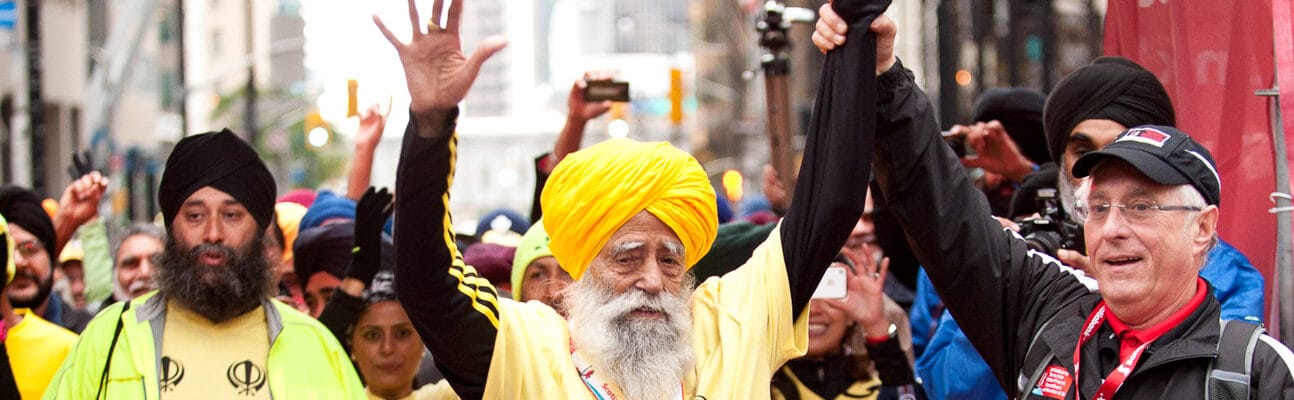
Of course, Fauja Singh made Steve Cobb look like a young man. Singh was born in Beas Pind in Jalandhar, Punjab in 1911. He was more than twice Cobb’s age when he decided to take up running. When Singh was 83, his 5th son, Kuldip, died. Singh was overcome with grief. He started to jog as a way of dealing with this loss.
Voice 1
Six years later, he became serious about long distance running. At the age of 89, Singh completed the London Marathon. This race of 42 kilometers took him six hours and fifty-four minutes to finish. It was a world record for his age.
Voice 2
He has since run marathons in Toronto, New York, and Mumbai. He became famous for his races at his age. Singh used his fame to raise money for several charities whenever he ran marathons. When he turned 100, he competed in the Ontario Masters Association Fauja Singh Invitational Meet. This was a competition held in Toronto. He set eight world age group records in one day at the meet. No one of his age has even tried to beat three of these records.
Voice 1
Simran Jeet Singh wrote a biography called Fauja Singh Keeps Going. Singh was a torchbearer at the London 2012 Olympics. He finally retired from running at 101 years old.
Voice 2
But he’s still alive and well. He is an inspiration to everyone. He said:
Voice 6
“The secret to a long and healthy life is to be stress free. Be grateful for everything you have. Stay away from people who are negative. Stay smiling and keep running.”
Voice 1
What does success mean to you? Can a person start again after a failure? You can leave a comment on our website at www.spotlightenglish.com. You can also find us on YouTube, Facebook, TikTok, Instagram, and X. You can also get Spotlight episodes delivered directly to your Android or Apple device through our free official Spotlight English app.
Voice 2
The writer of this episode was Peter Anderson. The producer was Michio Ozaki. The voices you heard were from the United States and the United Kingdom. All quotes were adapted for this episode and voiced by Spotlight. No AI or artificial intelligence was used in this episode. Spotlight episodes are written, voiced, and produced by real people for real people, no matter where in the world they live. This episode is called, “A Second Beginning.”
Voice 1
We hope you can join us again for the next Spotlight episode. Goodbye.
Question:
What does success mean to you? Can a person start again after a failure?






I think It us very difficult to find some job that you like so much. So, we must look for It and probably we’ll change our job neither once or twice but several times. We have to search our hapiness.
I am Severino Ramos. I am from Brazil and I live in São Paulo.
Dear Spotlight’s team; Megan Nollet, Patrick Woodward, Peter Anderson, and Michio Ozaki
How is it going?
A Second Beginning
First, I would like to thank you for bringing us followers of Spotlight Episodes, this so significant story about that theme, a second beginning. Thanks!
Question 1 –
What does success mean to you?
In my opinion, it means the fact that you achieved what you want; doing well and becoming famous, rich, etc: Hard work is the key to success. For example, a job that you do it well, is success.
Question 2 –
Can a person start again after a failure?
Yes, that person can.
It is very important to try again, and never give up on our goal.
Imagine this action, please.
When we were children, we crawled before walking, were not we? We were trying to walk on the floor. So we stood up to walk and we fell down on the floor. We stood up again and we fell down again. We have never given up until to getting our goal. And thanks God, we have been walking until now.
Finally, never give up on your goal! Try again to achieve your dream, your job that you really like to do well. This is what really matters for our heart and feeling. A failure for a brave, a proactive, and an intelligent person, it does not mean a lack of success. However, try again, believing in yourself, and cheering your dream.
Thank you so much for writing this so important article.
I appreciate it.
Stay with God.
Severino Ramos
Thank you so much Spotlight!
You are beside me over 4 past year to help improving my English skill as well as other knowledge about multiple topics!
I love you all so much and sincerely thank you!
You are welcome; thanks for letting us know!
Success is one of humanity’s greatest achievements, and every failure is another opportunity for success.
What does success mean to you? I believe that anything that you cannot do, however you did it. For example, someone disabled suffered mostly for his life but eventually he could walk. Afterwards, Someone cannot read in English for most of his life but eventually he can read English. Finally, I did 3 times a surgery and my family believes that I can walk well again, but I believe to my self and to the god that I will walk well again, despite my bad conditions. Eventually, now I can walk well again after 3 years of suffering. In conclusion, I believe this is the success.
Can a person start again after a failure?
Of course but he has to believe in himself and ignore the criticism of people because they will definitely criticize him. So many people change their careers and become successful