
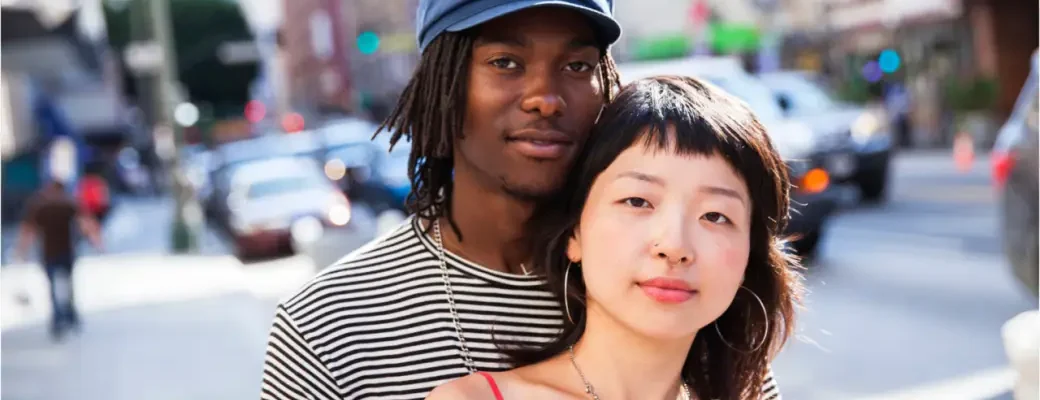
Voice 1
Welcome to Spotlight. I’m Colin Lowther.
Voice 2
And I’m Megan Nollet Spotlight uses a special English method of broadcasting. It is easier for people to understand, no matter where in the world they live.
Click here to follow along with this program on YouTube.
Voice 3
“Many people warned me about marrying someone from another culture. They told me it can be very difficult. It is true that there are some extra problems that we have had to think about. But in many ways, we are more prepared for this than other people who have married someone from their own culture. This is because we expect to have differences. Then when problems come up, we know how to deal with them,”
Voice 1
said Ruth Mico. Ruth Mico is British but now lives in Albania. Her husband, Maki, is Albanian. They have been married for almost three years. Their marriage has brought the British and Albanian cultures together. Intercultural marriages like this are common all over the world. However, many people still think they are unusual. In the past, some countries even had laws to stop people marrying someone from a different culture or race. Today’s Spotlight looks at some different opinions about intercultural marriages.
Voice 2
For some people, the idea of marriages between different cultures or races is a difficult subject. But intercultural marriages are becoming more common. As people move around the world, they meet people from many other cultures and countries. Some people think this has helped mixed marriages become more accepted. But other people think it has made what they see as a problem even bigger.
Voice 1
Some countries have a history of keeping different ethnic groups separate. These countries had laws to stop people of one race marrying someone from another. For example, this was true in South Africa from 1949 to 1985. During this time, it was against the law for white and black people to marry each other. Inter-racial marriages like this were also banned in the United States. But the United States finally changed this law in the 1960s.
Voice 2
Even in countries with no laws against mixed marriages, many people still thought that they were wrong. This can be seen in the story of a man called Seretse Khama.
Voice 1
The year was 1948. Seretse Khama had just been married. But not everyone was happy to hear about it.
Voice 2
Seretse Khama met his wife, Ruth Williams, in London. As a young man, he had moved to the United Kingdom to study. Seretse and Ruth got married after getting to know each other for one year. But this angered people back in Seretse’s own country.
Voice 1
Seretse was a leader in a country that is now Botswana. He had been a leader since he was four years old. But his father’s brother, his uncle, ruled the country. This was because Seretse was very young when he became a leader. However, his uncle was not happy that he had married a white woman. The government in South Africa was also not happy. This was when South Africa did not let black and white people marry each other. They did not want a man in a mixed marriage ruling a country that bordered them.
Voice 2
The South African government used its influence with the British against Seretse. The British government stopped Seretse from going back to his own country. He and Ruth were permitted to return only after Seretse gave away his right to lead his country.
Voice 1
Happily, the story did not end there. About ten years later, Britain ended its control of Botswana. Seretse stood for election to be the new leader. He won, and in 1966, Seretse became Botswana’s first president. Seretse Khama was once again the leader of his country. With the help of his wife, he ruled Botswana until his death in 1980. Many people now remember him as a great leader who did much for his country.
Voice 2
In other parts of the world, marriages between different races are normal. People in Brazil, for example, have been marrying people from different racial groups for many years. Hundreds of years ago there were three main ethnic groups. Black Africans, who were brought to the country as slaves. White Europeans moved to the country to settle. And native South Americans, who had lived in the area for thousands of years. Today, most Brazilians have a mix of these ethnic groups in their family history.
Voice 1
Some people think this mixing of different ethnic groups is a success for Brazil. Some say the mixture of races is what makes Brazil special. The country is not perfect for its equality between different racial groups. But marriages between different ethnic groups are still more common than in many other countries.
Voice 2
Mixed marriages can involve differences in home countries, culture, color of skin, or religion. Today, there are many different attitudes towards marrying someone from another race or culture.
Voice 1
Ruth Mico, whom we heard from at the beginning of the episode, is now expecting her first child. This child will experience both its parents’ cultures. Ruth and her husband Maki will also teach their child both the English and Albanian languages. They hope that this will help the child find its own special value in this mixing of cultures. Ruth said:
Voice 3
“For us both it is important that our child values its cultural history. Its spiritual life will also be important to us. This is something that as a family we will share together. My husband grew up in an anti-religious country. I grew up in a Christian country. However, we have both decided to follow Jesus. We hope and pray that our children will also decide this for their lives. As the child grows, it will choose its own culture. This could be more of one culture than the other. Or it could be a special mix. We will accept what they choose.”
Voice 2
How many couples do you know who have an intercultural marriage? Would your parents approve of it if you married someone from a different culture or a different race? What are the challenges for intercultural marriages or relationships? How can couples work through such differences? You can leave a comment on our website at www.spotlightenglish.com. You can also find us on YouTube, Facebook, TikTok, Instagram, and X. You can also get Spotlight episodes delivered directly to your Android or Apple device through our free official Spotlight English app.
Voice 1
The writer of this episode was from the Spotlight team. The producer was Michio Ozaki. The voices you heard were from the United Kingdom and the United States. All quotes were adapted for this episode and voiced by Spotlight. No AI or artificial intelligence was used in this episode. Spotlight episodes are written, voiced, and produced by real people for real people, no matter where in the world they live. This episode is called, “A Marriage of Cultures.”
Voice 2
We hope you can join us again for the next Spotlight episode. Goodbye.
Question:
How many couples do you know who have an intercultural marriage? Would your parents approve of it if you married someone from a different culture or a different race? What are the challenges for intercultural marriages or relationships? How can couples work through such differences?



I am Severino Ramos. I am from Brazil, and I live in São Paulo
Dear Spotlight’s team, Michio Ozaki, Colin Lowther, and Megan Nollet
How is it going?
A Marriage of Cultures
Question 1 –
How many couples do you know who have an intercultural marriage?
I know many couples who have an intercultural marriage.
I am sorry! But, I cannot tell you the correct number of them because at work, I know any couples who have an intercultural marriage. And here around me in my community where I live, there are some of the intercultural marriages.
Question 2 –
Would your parents approve of it if you married someone from a different culture or a different race?
I think so. My father lives in heaven with God. My mother, I believe. I am not sure about it. But I think that she would approve my future relationship with an intercultural person.
Question 3 –
What are the challenges for intercultural marriages or relationships?
Well, there are many challenges for intercultural marriages or relationships. However, you told us at the beginning of that episode many of them, like that: Mixed marriages can involve differences in home countries, cultures, color of skin, or religion.
Question 4 –
How can couples work through such differences?
Before answering that so important question, I ask you to tell you something about our body, please!
Our human body has several organs in and they work together to give it the correct performance or to work well, right?
So, our heart is the only organ that works alone.
It is an autonomous organ. It is a brilliant one.
May I tell you more about it, please?
When a person is going to die in a hospital bed with severe disease or due to an accident by a crash’s car, and the person’s brain stops working, the person continues alive.
Yeah! That is true! The person’s heart continues working until for some hours and It continues beating strong.
Why?
Because our heart is an autonomous organ. It works alone. It has its function. We cannot avoid its decisions even though we try to change them.
Sometimes, we hurt own hearts.
So, my final advice, we should follow our heart, and ask God to guide us.
The correct person to get married is that that like us with the whole heart forever. It does not matter where that person comes from, or was born.
Therefore, couples must deal with the differences between them.
Thank you so much for that significant episode.
I really appreciate it
Stay with God
Severino Ramos