
Voice 1
Welcome to Spotlight. I’m Alice Irizarry.
Voice 2
And I’m Patrick Woodward. Spotlight uses a special English method of broadcasting. It is easier for people to understand, no matter where in the world they live.
Click here to follow along with this program on YouTube.
Voice 1
Have you ever wondered how time works? What about memory? Have you thought about the difference between life and dreams?
Voice 2
Some people do not think about these questions. And, most writers do not explore them. But the Argentinian writer
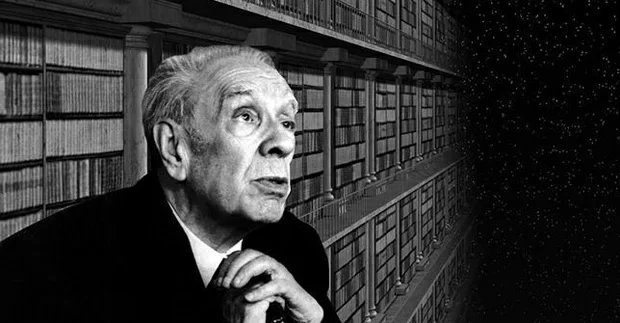
Jorge Luis Borges was not like other writers. Most of his writing explored these ideas. To many people, these ideas may seem strange. But in exploring them, Borges became one of the world’s most important writers.
Voice 1
Today’s Spotlight is on the Argentinian writer Jorge Luis Borges.
Voice 2
Borges wrote about many different subjects. Sometimes, he wrote about his own experiences. But often he wrote about subjects like time and memory. Much of his writing is difficult to define. It is mysterious, like a dream.
Voice 1
But Borges’ early life did not seem mysterious. The only unusual thing about young Borges was his eyesight. Even when he was young, he had a hard time seeing. So, he did not play outside as often as other children. And he did not make many friends. Instead, he spent much of his time inside, reading from his father’s books. His father had over a thousand books in many languages. And Borges tried to read them all. He read the Christian Bible, and stories from ancient Greece. He even read books full of facts.
Voice 2
For Borges, these books were the most important part of his young life. Gloria Lopez Lecube was an Argentinian journalist. In 1985, she talked to Borges. She asked when he knew he would become a writer. He said:
Voice 3
“I think I have always known. Maybe because my father had an influence on me. I was raised with my father’s books. I went to school. But that hardly matters, right? I was really raised among my father’s books. I always knew that it was what I was meant to do, being among books, reading them. But it would seem I was influenced to write as well.”
Voice 1
Borges’ father influenced him in other ways too. Borges’ father studied many subjects. He was a lawyer. And he also taught students. Often, he would speak to his son about very difficult subjects. They would talk about how memory is not perfect. They would speak about different ways to think about time.
Voice 2
Borges would later write about these subjects in his stories. One of the most interesting is called Funes the Memorious. An unnamed first-person writer, believed to be Borges himself, tells the story:
Voice 3
“The trouble began when Funes fell from the horse. The boy hit his head on a stone. And the fall broke his back. Today, he sits in his parents’ house in the country, unable to move on his own.”
Voice 1
Some people would probably love the power to remember. But Funes is in a difficult situation. He sits in the same place all day. His new memories are all the same. Instead, he spends most of his time in his memories. Each day of his past takes another day to remember. These memories cause problems for him. He finds it hard to sleep. He relives his life over and over again. By the time the writer of the story speaks to him, he has gone over his life many times. He is only nineteen. It seems as if he has lived many lives. But it is also as if he has not lived at all.
Voice 2
Borges began to publish his own work when he was very young. He was only twenty when he published his first poem. And his work soon became popular in literary circles around Argentina. People saw that his work was different. It played with the idea of what writing was. His ideas were like no one else’s.
Voice 1
Borges found it difficult to make money as a writer. Many people respected his work. But it did not sell well. So, Borges found work as a teacher. He spent much of his time reading and translating. What he did write was very short. Often, he wrote more about ideas than people. He created strange worlds and played with language.
Voice 2
Then, in 1941, he published one of his most important stories. It is called “The Garden of Forking Paths.” It was his first story translated into English. Before this, only a few people in Argentina knew his work. Now, people in other countries began to read it. In a very short time, Borges became well known. He traveled North America and Europe, giving speeches. His work began to win awards.
Voice 1
But by the time he was in his thirties, Borges’ eyesight had begun to fade. The process was slow. He lost the power to see some colors, first. At fifty, he could not see at all.
Voice 2
Later, Borges would write a poem about his experiences of losing sight. It is called “In Praise of Darkness”:
Voice 3
Old age (or so it is called by others)
can be the season of our happiness.
The animal has died, or nearly died.
The man remains, with his soul.
I live among vague and luminous shapes
that are not yet darkness.
My friends do not have faces,
women are what they were so many years ago,
the street corners have changed,
there are no letters in the pages of books.
All of this ought to terrify me,
but it is a sweetness, a coming back home.
From the south, from the east, from the west from the north
the roads converge,
the roads that have brought me to my secret center.
Those roads were echoes and footsteps,
women and men, death throes, resurrections,
days and nights,
dreams and between dreams,
every moment of yesterday, even the meanest,
and all of the yesterdays of the world.
Now I can let them go. I have come back to my center,
to my algebra, to my key,
to my mirror.
Soon I will know who I am.
Voice 1
He could not see. But Borges continued to write. Sometimes, he would speak his poems and stories out loud. He could no longer write long works. So he concentrated on small papers and poems. By the time he died in 1985 he had published dozens of books. He wrote almost half of them while blind.
Voice 2
Borges did not think that people would remember him. He thought that his writing was too difficult. Or, that his subject matter would not be important to them. But his writing had a profound influence on many people. He created the genre of magical realism. His work inspired mathematical theories. It also influenced science fiction and fantasy. But more than anything, Borges’ work changed Latin American writing.
Voice 1
Marcela Valdes is a literary critic. She spoke to the British Broadcasting Corporation about these changes:
Voice 4
“Borges’ influence on Latin American literature is like Sherwood Anderson’s effect on American fiction: very deep. It has become difficult to name a major writer who has not been touched by it.”
Voice 2
Have you ever read Borges? Do you have a favorite story, or poem? Tell us about it! You can leave a comment on our website. Or email us at spotlightenglish.com. You can also find us on YouTube, Facebook, TikTok, Instagram and X. You can also get our programs delivered directly to your Android or Apple device through our free official Spotlight English app.
Voice 1
The writer of this program was Dan Christmann. The producer was Micho Ozaki. The voices you heard were from the United States and the United Kingdom. All quotes were adapted for this program and voiced by Spotlight. No A.I., or artificial intelligence, was used in this program. Spotlight programs are written, voiced, and produced BY real people FOR real people, no matter where in the world you live. This program is called, “The Limitless Stories of Jorges Lois Borges.”
Voice 2
We hope you can join us again for the next Spotlight program. Goodbye.
Question:
Have you ever read Borges? Do you have a favorite story, or poem?



Thank you so much for telling this podcast. I have learned so many new techniques from this podcast also more vocabulary.
That’s great to hear! Thanks for letting us know.